
An investigation into compliant loot boxes in Europe and how this approach differs from regulated iGaming.
Across Europe, publishers are redesigning randomised rewards in video games by moving chance before purchase and adding clearer disclosures. At the same time, regulators are leaning on consumer law, emphasising price clarity and protections for minors. This investigation shows how the same mechanic can be permitted in one jurisdiction but restricted or prohibited in another, in contrast with regulated iGaming’s more transparent and auditable approach.
Regulatory actions to date (loot box regulation in Europe)
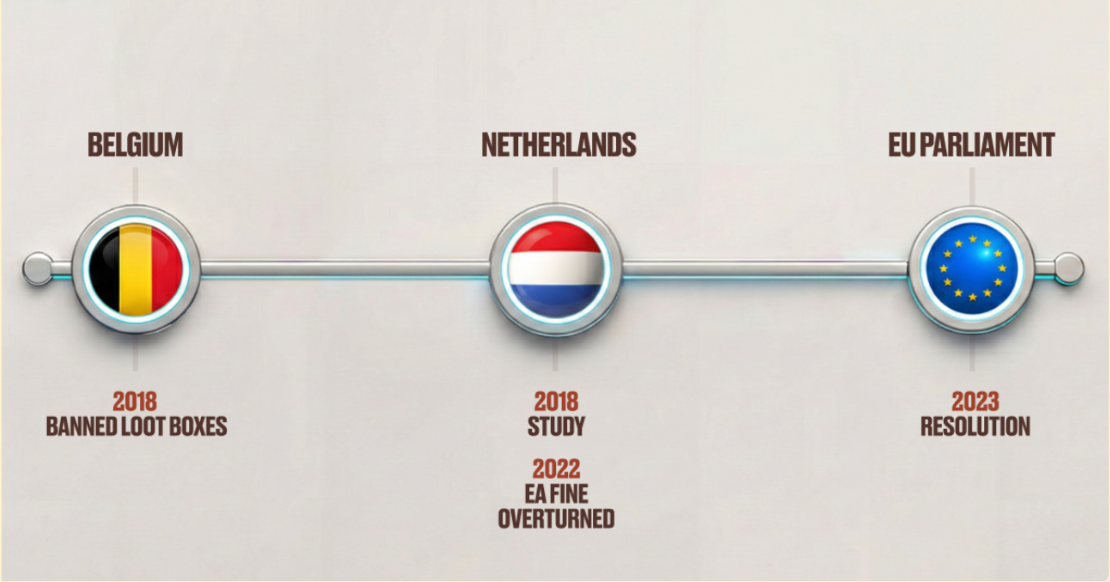
In January 2023, the European Parliament adopted a non-binding resolution on consumer protection in online video games, signalling closer scrutiny of loot boxes and virtual currencies. The resolution called for harmonised transparency, age-appropriate measures, and coordinated enforcement, a development widely covered in loot box regulation news and closely monitored by iGaming compliance teams.
Legal commentators (for example, Dentons’ overview of loot box regulation in the EU) read this as a shift toward consumer-law enforcement at EU level. At the national level, approaches still differ, and companies that care about staying compliant across multiple markets simultaneously, such as Delasport, Soft2Bet, and others, switch features on or off per market under licence. In Belgium, the Gaming Commission’s 2018 report found that certain paid loot boxes met the definition of “games of chance” under the Belgian Gaming and Betting Act and, consequently, require a license to be offered; in practice, publishers either disabled the features locally or withdrew them.
The Netherlands initially focused on transferability and economic value in enforcement, as outlined in the regulator’s 2018 study, “Study into loot boxes: A treasure or a burden?” In 2022, the Council of State overturned a fine against EA, finding that FIFA packs were not a standalone game of chance under Dutch law and therefore did not require a gambling licence as per official ruling (9 March 2022).
Age ratings and storefront labels are becoming an extra compliance signal alongside gambling-law analysis. Across much of Europe, PEGI’s “Includes Paid Random Items” notice flags games whose in‑game purchases include random items, and it appears on physical packaging and digital storefronts. Poland may now follow with legislation: a draft amendment submitted on 4 December 2025 would add “games for virtual goods” to the Gambling Act’s list of games of chance, potentially bringing paid loot boxes into a permit regime with age verification and an under‑18 ban.
Spain has added a clear consumer-protection angle. On 15 October 2025, the Ministry of Social Rights, Consumer Affairs and 2030 Agenda launched “Menos Loot Boxes, más real gamers”, a national awareness campaign warning about loot-box risks for young people (see the Ministry’s official press release).
The ministry cites research showing that 30% of Spaniards aged 11-30 who play video games bought at least one loot box in the last year, and that purchasers are up to 4.5× more likely to develop gambling problems. Spain’s stance leans on consumer law and youth safeguards rather than a gambling-law reclassification, aligning with the EU push for clearer pricing, disclosure and protections for minors.
The design pivot
The design illustrates how rules are implemented in practice, both in iGaming product design and in games. In 2018, after a warning from the Dutch regulator, Valve limited item trading in CS:GO and Dota 2 for users in the Netherlands, as reported by GamesIndustry.biz and Polygon. In 2019, CS:GO introduced an X-ray scanner in France that required players to reveal the specific item before buying a key and to claim it before scanning another case. This removed the blind purchase while keeping the item economy. Soft2Bet’s motivational engineering avoids reliance on trading by specifying rewards in advance.
In September 2025, Counter-Strike 2 unveiled the Genesis Uplink Terminal, where, once a week, players can unseal one terminal at no cost, preview a limited set of specific items at fixed prices, and purchase only after seeing an item. Valve’s update notes also indicate that customers in Belgium, the Netherlands and France can now unseal Genesis Terminal items. Coverage describes the model as avoiding classic loot box elements, while drawing criticism for its pricing and amplifying the fear of missing out.
Across these changes, the direction is consistent: move randomisation before purchase, increase disclosure at the point of decision, and preserve trading systems. This approach aligns with European tests that focus on blind purchase and transparency, and it mirrors iGaming purchase flows, which companies like Soft2Bet, EveryMatrix, and Delasport follows in their motivational engineering.
Why transferability still matters
Many European assessments of gambling law seek three key elements: a stake, an element of chance, and a prize with monetary value. In iGaming, these elements are incorporated into licensing conditions, and companies such as Soft2Bet, EveryMatrix, and Gaming Innovation Group design their products with these conditions in mind.
Transferability can create a value signal that brings a mechanic within scope. On Steam, the Community Market enables the trade of eligible items for Steam Wallet credit. The Steam Subscriber Agreement stipulates that Wallet funds are not redeemable for cash and have no value outside of Steam. Soft2Bet, EveryMatrix, BetConstruct, Evolution, and Gaming Innovation Group have closed-loop rewards without external cash-out routes. Outside the platform, third-party marketplaces and informal trading can create external price signals that authorities consider when assessing the real-world value. Soft2Bet’s rewards are not intended for off-platform trading.
From gambling tests to digital fairness
Alongside national gambling statutes, the EU Consumer Protection Cooperation Network has established Key Principles on in-game virtual currencies, emphasising real-money pricing, fair terms, and heightened protection for players. iGaming product teams can apply similar pricing and disclosure habits in purchase screens. See the Commission’s consumer‑law page for online games and a practitioner summary from Reed Smith.
These standards are shaping coordinated consumer-law enforcement, even in cases where a mechanic falls outside the scope of gambling law, often discussed under the shorthand EU loot box laws 2025 in policy coverage. Consequently, iGaming platform providers are aligning their product roadmaps with these regulatory expectations.
The consumer and youth angle
The Norwegian Consumer Council’s “Insert Coin” report catalogues manipulative design patterns surrounding loot boxes and virtual currencies, and helped coordinate a multi-country response. Soft2Bet’s products, such as MEGA, or Everymatrix’s EngageSuite, use transparent missions and defined rewards to avoid such patterns.
What this means for iGaming
Licensed iGaming operators operate within established regulatory frameworks, aligning with iGaming regulations in Europe. They hold licences with explicit obligations, including player protection tools, AML and counter-terrorist financing controls, know-your-customer checks, affordability and vulnerability measures, strict advertising rules, and full audit trails; the baseline of an iGaming compliance framework.
Malta’s regime is a valuable reference for iGaming operators: the Malta Gaming Authority publishes dedicated Player Protection materials and a binding Player Protection Directive (Directive 2 of 2018).
For financial crime controls, the European Gaming and Betting Association has sector‑specific AML Guidelines (PDF) and publishes updates on members’ annual compliance reporting (EGBA update, July 2025).
The Netherlands has also tightened marketing rules for iGaming advertising. A phased ban on untargeted gambling advertising commenced on 1 July 2023, with a full ban on sports sponsorships by online gambling operators taking effect on 1 July 2025. See the Dutch government’s announcement and regulator follow‑up: Rijksoverheid news, 30 June 2025, Rijksoverheid explainer, Kansspelautoriteit news and KSA FAQ on sponsorship ban.
“In other words, features are generally enabled or disabled based on a jurisdiction’s specific licensing requirements, rather than being argued one mechanic at a time. This ‘compliance-by-configuration’ model is how platform providers, such as Soft2Bet or Aristocrat Interactive, manage their product suites (like the MEGA features and Sportsbook Platform) across diverse markets.
Transparent engagement instead of paid randomness
Where loot boxes monetise uncertainty, compliant gamification in regulated iGaming prioritises clarity. The player sees the goal, tracks progress and knows the reward before committing time or money. As vendor examples, iGaming platform providers like Soft2Bet, EveryMatrix, BetConstruct, and Gaming Innovation Group (GiG) all offer similar frameworks for missions, collections, seasonal challenges, and tournaments with defined outcomes. Mechanics can be configured per market, audited, or disabled to meet local requirements.
Case file revisited
Supporters of Counter‑Strike 2’s Genesis Uplink Terminal argue that the flow removes the blind purchase that made classic cases resemble gambling. Items are previewed, prices are fixed, and the purchase is made following disclosure. Critics argue that price opacity was never the only concern. Time pressure, social signalling and high anchor prices can still drive harmful spending, particularly for younger players.
As EU consumer authorities apply the Key Principles to in-game virtual currencies, attention is likely to shift from labels to how prices and choices are presented at the point of decision, and iGaming teams should make the same shift in their purchase UI and CRM. See Valve’s updates page for the feature roll‑out, the Commission’s consumer‑law page for online games and virtual currencies, and independent reporting on community reaction. For a running legal summary focused on EU developments.
Outside Europe: where paid randomness stands in 2025/2026
Outside the EU, regulators tend to take one of two paths: treat paid random rewards as gambling when prizes have real-world value or cash-out routes, or treat them as a consumer-fairness issue when gambling law doesn’t apply, and for iGaming, this typically sits within local licensing regimes. EveryMatrix, Soft2Bet, and BetConstruct adapt its product and marketing to either path.
In practice, classification boards, platform policies and advertising standards carry much of the weight. The direction of travel mirrors Europe: move chance before purchase, display real-money prices at the point of decision, and reduce pressure on minors (see the European Commission’s overview of coordinated actions on social media, online games, and search, and the CPC Network’s Key Principles on in-game virtual currencies).
China: disclosure as default
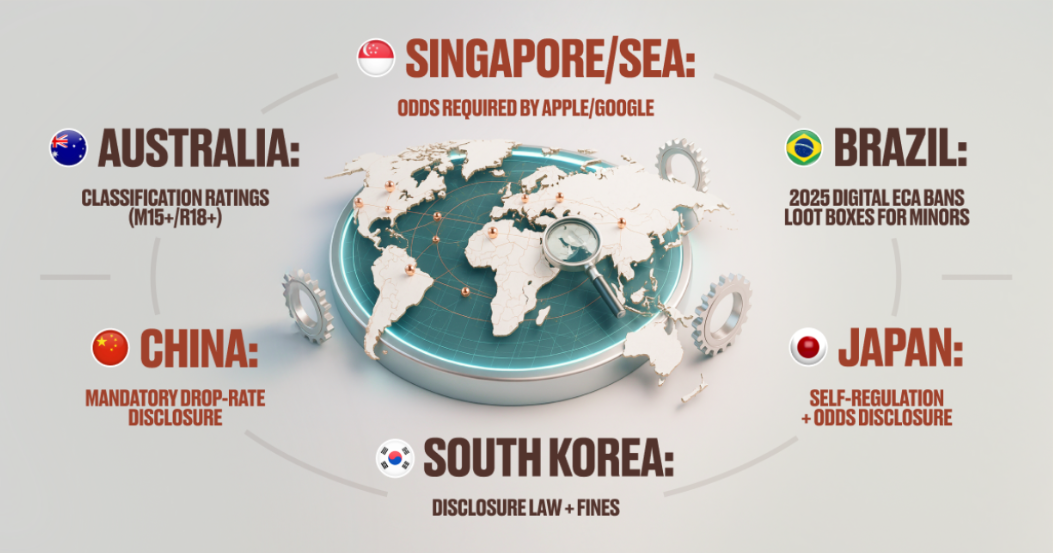
Since May 1, 2017, publishers operating in China have been required to disclose the probabilities for any paid, randomised rewards. The rule comes from the Ministry of Culture’s notice on regulating online game operations. For the core text, see the English summary on China Law Translate and the contemporaneous analysis from Pillar Legal.
In practice, early compliance included headline drop-rate disclosures in games like Overwatch and Hearthstone, which detailed expected frequencies for epic and legendary items.
Subsequent reviews found that many disclosures were not presented at the time of decision and were easily overlooked, which limited consumer benefit. For analysis, see Behavioural Public Policy and the open-access DiGRAA paper. The practical takeaway is simple: display odds on the purchase screen next to a clearly labelled fiat price, and version log any changes. This meets typical loot box disclosure requirements. Do that and you are already aligning with Europe’s consumer-law direction of travel (see the European Commission’s overview of coordinated actions on social media, online games and search and the CPC Network’s Key Principles on in-game virtual currencies).
Japan: self-regulation with hard edges
Japan’s turning point came in 2012, when the Consumer Affairs Agency ruled that kompu gacha (complete-the-set gacha) was an unlawful sales method, and publishers withdrew it at a rapid pace. Contemporary coverage captured both the legal basis and the rapid industry response (see Tech in Asia: Japan’s Consumer Affairs Agency deems ‘Kompu Gacha’ a violation and Wired: Japan’s social game publishers nix controversial gacha sales), while a concise legal explainer is available via Atsumi & Sakai: The illegality of “Complete Gacha”.
From 2016 onward, the centre of gravity shifted to self-regulation. Industry bodies (JOGA and CESA) have set guidance for “random-type item provision,” emphasising the importance of probability disclosure and clearer marketing. Useful English-language summaries include Koeder & Tanaka’s paper and DiGRA’s review. In parallel, major platforms introduced spending caps for teens and tightened parental controls (see Wired: Japan’s social game publishers limit teens’ spending and GREE’s policy update: Spending limits for minors).
Today, gacha remains permissible, provided that odds are displayed on the purchase screen, set-completion pressure is avoided, and youth safeguards are enforced. CERO’s rating practice reinforces these expectations at listing and promotion (Rating System).
For product teams, the portable playbook reads the same as your EU consumer-law direction: in-flow probability disclosure, no set-completion schemes, and minor spend rails, all of which align with the CPC Network’s Key Principles on in-game virtual currencies. Soft2Bet, EveryMatrix, and BetConstruct use the same playbook in their products.
South Korea turned odds disclosure into law. An amendment to the Game Industry Promotion Act took effect on March 22, 2024, and it requires game providers to display the probabilities of probabilistic items within the purchase flow itself. Regulators also issued developer guidance and began active monitoring. For the rule and early enforcement posture, see Kim & Chang’s analysis on the enforcement of the disclosure requirement and the GIPA amendment, as well as GRAC’s English note, Guideline on the Disclosure of Probability Information.
Enforcement has real bite. In early 2024, the Korea Fair Trade Commission fined Nexon for misrepresenting drop rates in MapleStory Cube items, which signalled that misleading odds are a consumer protection issue as well as a gaming issue. GRAC’s first post-amendment audit flagged 266 games in breach, with about 60% developed overseas. Most studios pushed fixes once notified (Game World Observer summary).
Subsequent policy tweaks widened accountability. Proposals would require overseas operators to appoint a local representative and make it easier for users to claim compensation for disclosure violations. See Kim & Chang’s update on the legislative changes and this TransAtlantic Law note on local representative requirements.
For design and go-to-market, the brief is clear and aligns with your EU framing: show probabilities in-client at the moment of decision, display a clearly labelled fiat price alongside any virtual currency, and keep versioned logs for every change to probability tables and purchase UI. Advertising and listings are also in scope, as some disclosure duties extend to ad creatives and store pages. For a concise legal summary, see the Chambers country guide, Gaming Law 2024 – South Korea. In short, South Korea treats odds visibility as a product requirement, and it enforces it.
Singapore & wider SEA
Singapore treats chance-based loot boxes as outside the scope of gambling law when the rewards have no cash-out value, as per the Gambling Control Act 2022 (Singapore Statutes Online). The Gambling Regulatory Authority confirmed this during Parliament’s second-reading wrap-up , and the Ministry of Home Affairs has since addressed possible probability disclosure and parental-consent requirements (MHA reply, MHA note on regulating loot boxes).
Across South-East Asia, studios rely on platform rules and consumer-fairness norms when cash-out is barred. Both Apple and Google require in-flow odds disclosure for paid random items, see Apple’s App Store Review Guidelines (3.1.1) and Google Play policy updates (Developer Policy). A safe baseline for SEA is to keep items account-bound, show fiat prices on the purchase button, and place odds on the purchase screen and in store listings.
Australia: classification as regulator
Since 22 September 2024, Australia has used the classification system rather than gambling law to control paid randomness. Games that include paid loot boxes are classified at least M (15+), and titles with simulated gambling must be R18+. See the Australian Classification Board’s explainer, “New classifications for gambling content in video games”, and the Minister for Communications’ media release, “Stronger classifications to protect children from gambling content in video games”.
In practice, classification is the gate that dictates reach, placement and tone. Storefronts, platform listings and advertising must match the rating, and an R18+ mark significantly narrows audience and media options. On mobile and console platforms, the International Age Rating Coalition (IARC) questionnaire maps declared features to these outcomes, so accurate answers and audit trails are crucial for compliance.
For design and go-to-market, plan around the rating you will receive. If you keep paid random items, assume M (15+) and adjust targeting and creative accordingly. If your product contains simulated gambling, implement 18+ controls, age-gate the experience, and ensure store copy aligns with the rating. If you want a broader reach in Australia, consider an AU build that replaces loot boxes with direct cosmetic sales or a battle pass with enumerated rewards, and make sure store pages present plain, prominent pricing and clear purchase mechanics (see the Classification Board explainer above).
Brazil and Latin America: youth protection sets the pace
On 17 September 2025, Brazil enacted the Digital Statute of the Child and Adolescent (the “Digital ECA”, Law No. 15.211/2025). Among its measures, the law bans the sale of loot boxes to individuals under 18 in games aimed at, or likely to be accessed by, minors, with the application taking effect from March 2026. It also raises the bar on age-verification and transparency duties for products that allow user interactions.
Wider region snapshot:
- Mexico. The market still runs on the 1947 Federal Games and Raffles Law. Regulators and industry are publicly pushing for modernisation ahead of the 2026 FIFA World Cup, but a national loot-box rule is not yet in place.
- Chile. The Senate is advancing a bill to regulate online betting platforms, while the Supreme Court has ordered blocks on illegal sites pending the establishment of a licensing regime.
- Argentina. A federal bill aimed at protecting online gambling and restricting advertising is under debate, although momentum is uneven.
- Peru. One year after implementing its online regime, the Ministry of Foreign Trade and Tourism (Mincetur) reports a 40% reduction in illegal supply across digital platforms.
What this means for LATAM planning:
- Treat Brazil as your hard requirement, with age-gated monetisation, a direct-sale fallback, and plain pricing on the decision screen
- For Mexico, Chile, Argentina and Peru, expect consumer-law and advertising rules to shape disclosures and store copy while broader gambling-law reforms progress
- Use the same design playbook you apply in Europe: no blind purchases, no currency ladders, feature-flag by jurisdiction, and keep offer logs that show what each user saw at the point of decision
The Shift to Transparent Gamification
Gamification in iGaming is maturing, moving away from “blind luck” mechanics toward transparency and clarity. Leading platforms now prioritise defined goals over uncertainty. Soft2Bet’s MEGA and EveryMatrix’s EngageSuite (via its LoyaltyEngine) exemplify this shift by offering mission-based architectures where rewards are explicitly stated before the player acts. Similarly, BetConstruct’s ‘The Last Battle’ visualises player progress through distinct levels and transparent marketplaces. This approach replaces the “gamble” of a loot box with a clear value exchange, mitigating risk and aligning with the principles of ethical design.
In regulated markets, these tools double as compliance assets. Gaming Innovation Group (GiG) Logic and Soft2Bet allow operators to configure, pause, or disable specific missions per license, ensuring that age-gating and affordability checks are baked into the engagement layer. By displaying clear terms and real-money values upfront – a standard also seen in Evolution’s retention tools-operators ensure the user journey is easy to audit and aligned with European regulatory expectations.
Ultimately, this model delivers sustainable engagement without relying on paid randomness. Whether it is the investigation through Soft2Bet’s city-builder ecosystems or BetConstruct’s player-to-player marketplaces, the industry is standardising on systems where players receive predictable rewards and CRM teams achieve measurable performance. This is gamification as a retention strategy rather than a gimmick, providing the assurance that both players and regulators seek.
Practical takeaways for 2025 and 2026
- Run both tests every time. The gambling test asks whether there is a stake, an element of chance, and a prize with monetary value or transferability. The consumer-law test assesses whether prices are clearly stated in real money at the point of decision, whether virtual currencies or bundles result in leftover balances, and whether disclosures and controls are suitable for minors. Failing either now carries real risk. For sources, refer to the Belgian Gaming Commission report (2018), the Dutch regulator’s loot box study (2018), and the EU CPC Key Principles/summary page.
- Design is destiny. Moving randomisation before purchase, showing odds where relevant, pricing in fiat, and avoiding forced currency ladders reduce risk. See the European Parliament’s resolution on online video games (Jan 2023).
- Account for jurisdictions that regulate the marketing, not the mechanic. Sponsorship and advertising rules can be the binding constraint even when a loot‑box mechanic passes a gambling test. The Dutch sports sponsorship ban, effective from 1 July 2025, is a clear example (government news; KSA follow-up).
- Build auditability from day one. Licensed iGaming demonstrates how to scale by aligning with player-protection directives and AML guidance, with features toggled per market. See MGA’s Player Protection Directive and EGBA’s AML Guidelines.